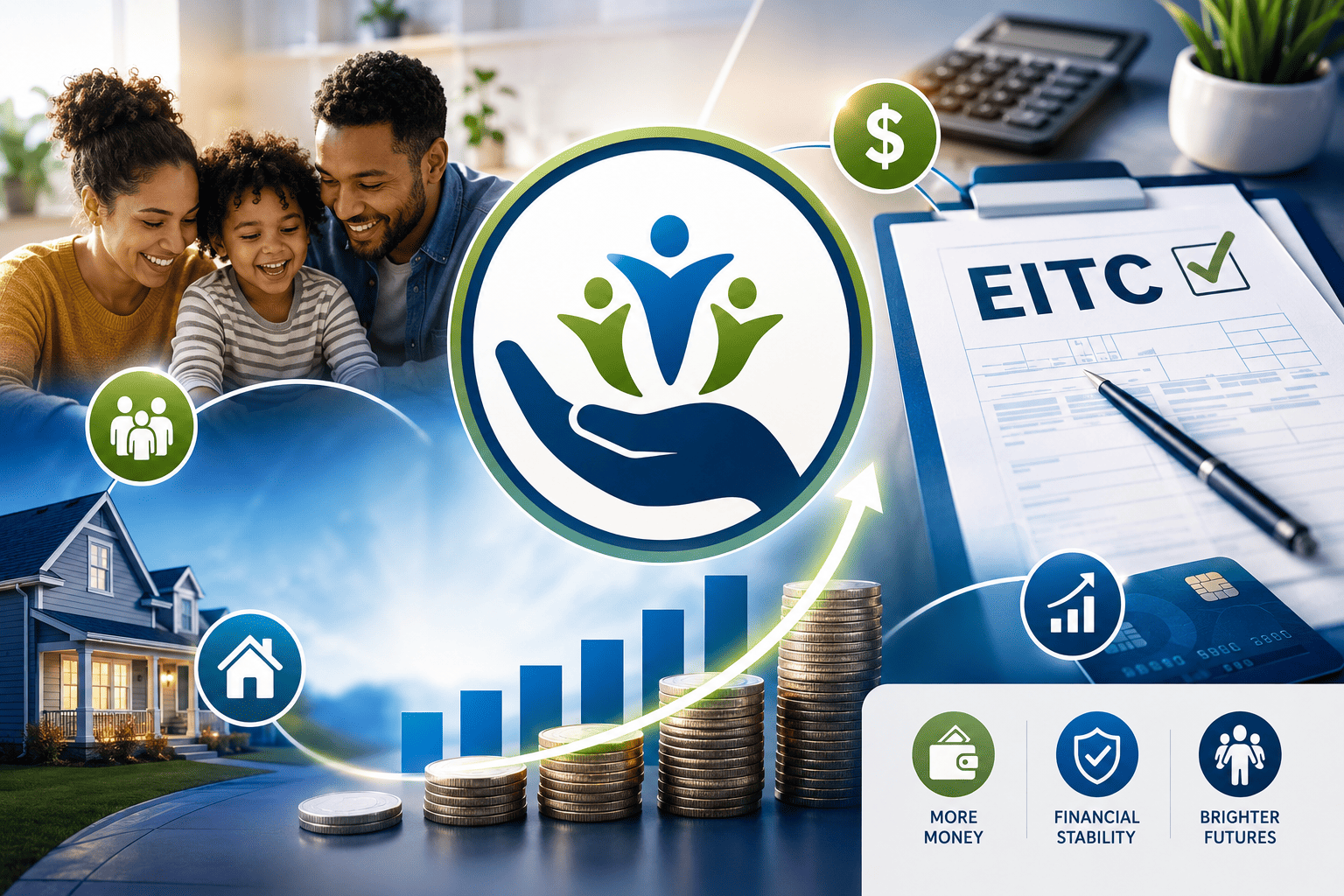
The Earned Income Tax Credit (EITC) is one of the most valuable Support Systems that works through your taxes — yet many households who qualify never claim it. The reason is almost always confusion, not ineligibility. Here is the EITC in plain English.
What the EITC Actually Does
The EITC is a credit for people who work but earn a low to moderate income. Unlike a deduction, which only reduces taxable income, a credit reduces the tax you owe dollar for dollar. The EITC is also refundable, which means if the credit is larger than your tax bill, the difference comes back to you as a refund.
Who It Commonly Applies To
Eligibility depends mainly on three things:
- Earned income. You need income from work — wages or self-employment.
- Income limits. Your income must fall under a published threshold that rises with the number of qualifying children.
- Filing status and dependents. The credit grows with each qualifying child, but workers without children may still qualify for a smaller amount.
You have to file to claim it
The EITC is not automatic. Even households with income low enough that they are not required to file a return must file to receive the credit. That single step is the most common reason eligible families miss it.
How to Tell If It Fits Your Household
Because the limits change with household size and filing status, the best approach is to compare your earned income and number of qualifying children against the current year's thresholds. Our free Tax Offset Estimator gives you a quick read on whether the EITC and similar credits are worth exploring before you file.
What “Earned Income” Really Means
The word “earned” does a lot of quiet work in this credit, and understanding it removes much of the confusion. Earned income is money you receive in exchange for work — the wages on a paycheck, tips, and the net profit from self-employment. It is different from money that arrives without work behind it, such as interest, most retirement distributions, or unemployment payments. The EITC is built specifically to reward and support people who are working, so the credit looks first at this work-based income.
This distinction matters in practical ways. A household living mostly on non-work income may not qualify even with a modest total, while a household with steady wages near the lower end of the scale may qualify for a meaningful amount. If your situation includes a mix of income types, it is worth separating the earned portion in your mind, because that is the number the credit cares about most.
- Counts as earned income. Wages, salaries, tips, and net self-employment earnings.
- Generally does not count. Interest, dividends, most pensions, and similar income that does not come from work.
- Self-employment included. Income from gig work, freelancing, or running a small business is earned income, even without a traditional paycheck.
Why a Refundable Credit Is So Valuable
It is easy to skim past the word “refundable,” but it is the feature that makes the EITC so meaningful for working households. Most tax benefits can only reduce what you owe down to zero. A refundable credit goes further: if the credit is larger than your tax bill, the leftover amount is paid to you. In other words, the EITC can do more than erase a tax bill — it can turn into money that comes back to your household.
For families with low to moderate earnings, this can be one of the most significant financial events of the year. Because the amount is tied to how much you earned and how many qualifying children you have, two households with similar incomes can receive very different credits. That is by design: the credit is shaped to provide more support where there are more people to support.
The credit rises, then gradually phases out
The EITC follows a curve rather than a flat line. As earned income increases from a low level, the credit grows, reaches a peak across a range of incomes, and then slowly shrinks as income rises past a certain point. This is why a small change in income usually leads to a small change in the credit — not a sudden cliff — and why it is worth checking even if you think you might be near the edge.
Understanding “Qualifying Children”
Much of the credit's size depends on whether you have qualifying children, and the definition is more specific than the everyday meaning of the word. A qualifying child generally has to meet tests related to their relationship to you, their age, where they live, and whether someone else could also claim them. These rules exist to make sure the credit follows the household that is actually raising the child.
- Relationship. The child is typically your son, daughter, stepchild, sibling, or a descendant of one of these.
- Age. There are age limits, with allowances for students and for children who are permanently disabled.
- Residency. The child generally must live with you in the United States for more than half the year.
- No double-claiming. Only one household can claim a given child for the credit.
If you do not have qualifying children, do not assume the door is closed. Workers without children may still qualify for a smaller version of the credit, provided they meet the age and income conditions. This group is among the most likely to overlook the credit entirely, simply because they assume it is only for larger families.
Common Reasons Eligible Families Miss Out
The single biggest reason eligible households do not receive the EITC is that they never file a return, often because their income is low enough that filing is not otherwise required. Since the credit only arrives when you claim it, that one missing step quietly costs families the entire benefit. But there are other patterns worth knowing so you can avoid them.
- Assuming you earn too little. Low earnings are exactly the situation the credit is built for, but you still have to file to claim it.
- Assuming you earn too much. The phase-out is gradual, so it is easy to be eligible even when you feel above the line.
- A change in life circumstances. A new child, a job change, or a shift in income can newly qualify a household that did not qualify before.
- Self-employment confusion. Gig and freelance workers sometimes do not realize their net earnings count as earned income.
Keeping Good Records Through the Year
Because the credit depends on accurate figures for your earned income and your household, a little organization through the year makes filing far smoother. You do not need an elaborate system — just a reliable place to keep the documents that show what you earned and who lived in your household. When filing season arrives, having these in one spot turns a stressful task into a straightforward one.
For self-employed and gig workers, this is especially worthwhile, since your net earnings — income minus business expenses — are what the credit uses. Tracking both sides through the year means you can report an accurate number rather than guessing, which protects both your eligibility and your peace of mind.
Putting the Pieces Together
The EITC rewards work, grows with the number of qualifying children, and can return money to your household even when you owe nothing. The rules around earned income, qualifying children, and the gradual phase-out can look intricate at first, but they all point in the same direction: the credit is designed to reach working households across a wide range of situations. The most important takeaway is simple — you have to file to claim it, and it is almost always worth checking whether it fits, even in a year when your circumstances have changed.
The rest of this guide is for Members
You've read the first half free. Unlock the full guide to keep reading the remaining steps, checklists, and details.
Unlock With Member