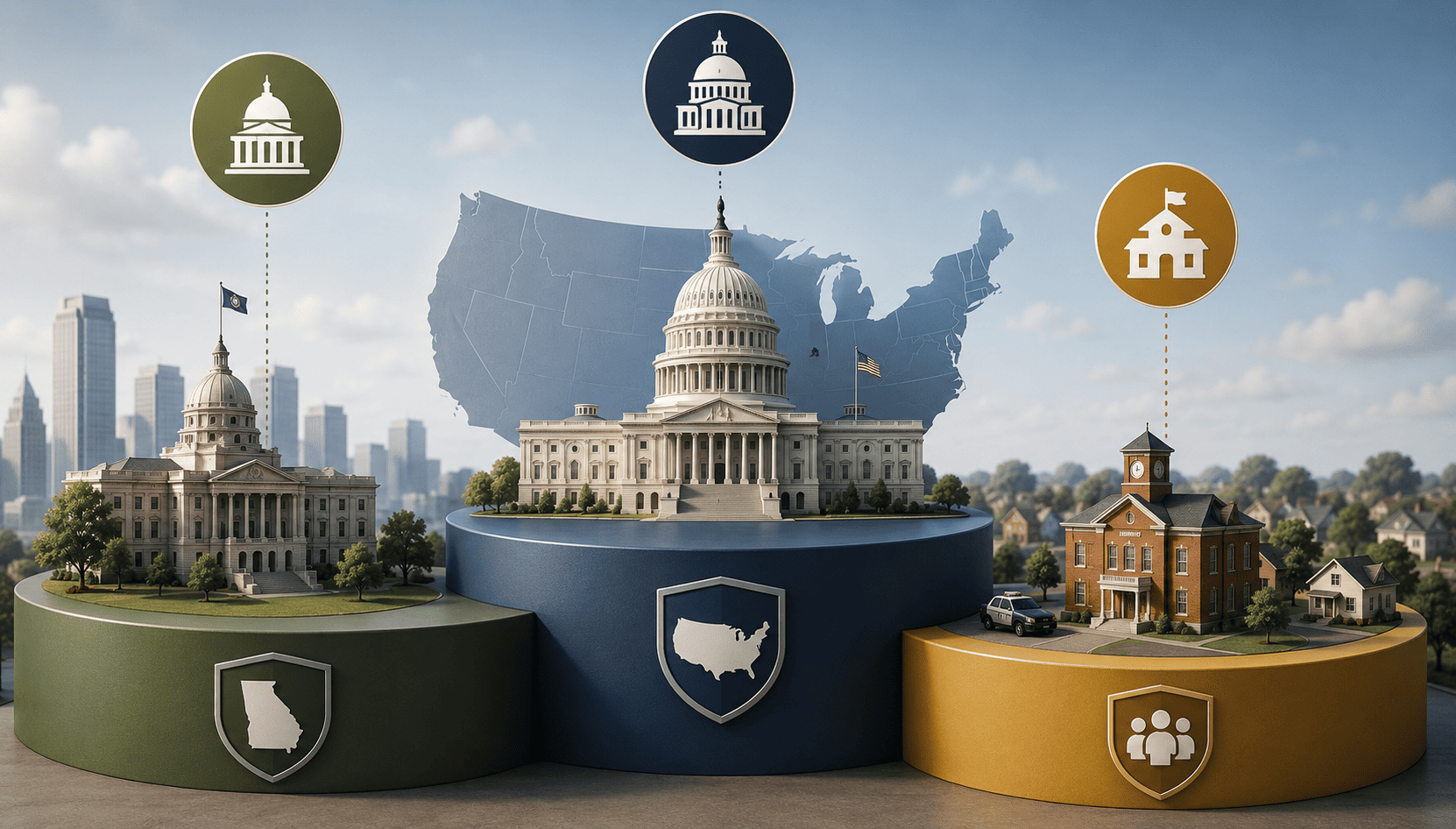
One of the most confusing parts of navigating Support Systems is that the same program can behave completely differently depending on where you live. The reason is simple once you see it: programs are run at three levels — federal, state, and local — and each level sets its own rules within the boundaries above it.
The Three Levels Explained
- Federal. The national government funds and sets the broad rules. Federal programs aim for consistency across the country, but they often hand day-to-day operation to states.
- State. States adapt federal programs to local needs and run many of their own. This is why income limits, names, and application steps vary from one state to the next.
- Local. Counties, cities, and nonprofits deliver programs on the ground — and sometimes add their own. This is where you actually apply and get help.
Why the same program has many names
A federal energy program might be called one thing nationally but appear under a different brand in your state. The underlying rules are similar, but the front door — the office you contact — changes by location. Always search using your state's name alongside the program type.
Where to Start Looking
Knowing who runs what saves hours of searching in the wrong place. As a rule of thumb:
- For broad eligibility rules, start with the federal program overview.
- For income limits and application steps, look at your state's agency.
- For help applying, contact a local office or community nonprofit.
Putting It Together
When you understand the level a program lives at, you instantly know where to look for accurate information and who can actually help you apply. Our tools point you to the right level for each Support System so you do not waste time on the wrong office.
A Closer Look at the Federal Layer
The federal layer is best understood as the place where the broad promises are made. When the national government decides that a category of need — energy, food, healthcare, housing — deserves support, it sets the outer boundaries: who is broadly eligible, what the program is meant to accomplish, and how much funding is available. What the federal layer almost never does is sit across a desk from you. It writes the framework and then sends the money downstream for others to deliver. That single fact explains most of the confusion households feel.
Because federal rules are written for the entire country, they tend to be general by design. They describe ranges rather than exact figures, and they leave room for states to fill in the specifics. When you read a federal overview, treat it as the map legend rather than the map itself: it tells you what the symbols mean, but you still need your state’s version to find the actual roads.
What States Actually Control
States are where general promises become concrete rules. Working within the federal framework, a state decides the precise income limits it will use, the documents it will request, the name it will give the program, and the office that will run it. Two neighboring states can take the same federal dollars and build noticeably different programs — one with a slightly higher income cutoff, another with a faster application, a third with extra services layered on top. None of them is breaking the rules; they are simply exercising the flexibility the federal layer hands them.
This is the single most important reason to always search with your state’s name attached. A program description you find for one state may be accurate there and misleading three hundred miles away. The underlying need the program addresses stays the same, but the threshold you must meet and the paperwork you must bring can shift entirely across a state line.
The Local Layer: Where Help Becomes Real
The local layer — counties, cities, community action agencies, and nonprofits — is where an abstract program turns into a person who can help you. This is the level where applications are submitted, where documents are reviewed, and where someone can answer the question the website did not. Local offices also frequently add their own programs on top of the federal and state ones, funded by city budgets, local foundations, or charitable partners. These local-only options are some of the most overlooked sources of help precisely because they never appear in national searches.
If the federal layer is the legislature and the state layer is the rulebook, the local layer is the front desk. When you are ready to act, the local office is almost always your destination — even for programs that were created and funded far above it.
Keep a one-page program log
For every program you explore, write down four things: which level runs it, the exact office or website that handles it in your area, what it is called locally, and the documents it asked for. A single page like this prevents you from re-searching the same program twice and makes it easy to pick up where you left off.
How Money and Responsibility Flow Between the Levels
It helps to picture the three levels as a relay. The federal layer provides the funding and the outer rules and then passes the baton to the states. Each state shapes the program to fit its residents and then passes the baton again to local offices and community partners. By the time the help reaches your household, it has traveled through all three hands. Every handoff is a chance for the program to be renamed, adjusted, or paired with something local — which is exactly why the version you experience can look so different from the national description you first read.
Understanding this flow also tells you where to ask which question. Big, “am I broadly the kind of household this is for” questions are answered at the federal level. “What is the exact limit and how do I apply” questions are answered at the state level. And “can you help me finish this and what else is available nearby” questions are answered locally.
Why the Same Household Gets Different Answers in Different Places
Few things are more frustrating than hearing that a friend in another state qualified for something you were told you did not. Usually nothing is wrong — you have simply run into the flexibility built into the system. Your friend’s state may set its limit a little higher, count income a little differently, or run a local add-on that yours does not. The lesson is not that the system is unfair so much as that it is local. Comparisons across state lines are interesting but rarely decisive; the only answer that matters for you is the one produced by your own state and county’s rules.
A Practical Map for Navigating All Three Levels
When a program looks promising, walk down the levels in order rather than jumping straight to an application:
- Start federal to understand the purpose. Read the national overview just long enough to confirm the program is meant for a situation like yours.
- Move to your state for the real rules. Find the income limits, the household-size details, and the document list that actually apply where you live.
- Finish locally to apply and ask questions. Identify the county office or community partner that processes the program, and let them help you complete it and point out anything extra nearby.
Reading Between the Levels
As you move through the layers, a few habits keep you from getting lost:
- Always pair a program name with your state when you search.
- Assume the local name may differ from the national one.
- Trust the state page over a national page for income limits.
- Ask the local office whether any city or county add-on exists.
- Write down who told you what, so you can follow up accurately.
When the Levels Overlap
Sometimes a single need is addressed at more than one level at once — a federal program, a state supplement, and a local charity may all touch the same bill. This is not a contradiction to untangle so much as an opportunity to stack. It is common and entirely legitimate for a household to combine a federally funded benefit with a separate, locally funded one, as long as each program’s own rules are met. The key is to ask each office a simple question: “Is there anything else, at any level, that pairs with this?”
Common Pitfalls When Crossing Levels
- Reading only the national page. It tells you the idea but rarely the limit you will actually be measured against.
- Calling the wrong office. Federal agencies usually cannot process your application; the local office almost always can.
- Assuming a name is universal. The same program may carry a different brand in your county, hiding it from a plain search.
- Stopping after one program. Local add-ons are easy to miss and are often the difference between partial and full help.
A Calm Way to Approach the Maze
Three levels can sound intimidating, but the structure is actually your friend once you see it. Each level answers a different question, so instead of one overwhelming search you have three small, clear ones: what is this for, what are my exact rules, and who can help me finish. Work them in that order and the maze becomes a short hallway. Our tools are built to point you to the right level for each Support System, so you spend your energy on the office that can actually help rather than the one that cannot.
A Short Glossary Worth Knowing
A few words come up again and again as you move between levels, and knowing them quietly removes a lot of friction:
- Administered by — the office that actually runs a program day to day. This is usually a state or local body even when the funding is federal.
- Funded by — where the money originates. Federal funding can flow into a program that a local office delivers, so funding and delivery are not the same thing.
- State plan — the version of a federal program a state has chosen to build. When two states differ, it is usually their state plans that differ.
- Local supplement — an extra layer of help a city, county, or nonprofit adds on its own. These rarely appear in national searches and are easy to miss.
None of these terms is complicated, but recognizing them tells you instantly whether the page in front of you is describing the big idea, the rule you will be measured against, or the office that can actually help.
Questions to Ask Any Office
Whichever level you reach, a small set of questions gets you the answers that matter quickly. Keep these handy whenever you call or visit:
- What is the exact income limit for my household size in my area?
- What is this program called locally, in case I need to search again?
- Which documents should I bring, and in what form?
- Is there anything at another level — state or local — that pairs with this?
- When would I need to renew, and how will I be reminded?
Asking these five questions turns a confusing call into a productive one, and the answers fit neatly onto the same one-page log described earlier. Over time, that log becomes your personal map of which level runs what — and the three-layer system stops feeling like a maze and starts feeling like a directory you already know how to read.
The bottom line is steadying: you do not need to master every program at every level. You only need to know which of the three layers answers each question, ask that layer plainly, and keep a simple record of what you learn. Do that, and the federal, state, and local maze becomes a path you can walk with confidence — one clear question, and one helpful office, at a time.
The rest of this guide is for Members
You've read the first half free. Unlock the full guide to keep reading the remaining steps, checklists, and details.
Unlock With Member